HackHub Ultimate Hacker Simulator HackHub Content SDK
Author missions, apps, and events inside the simulation — publish via Steam Workshop.
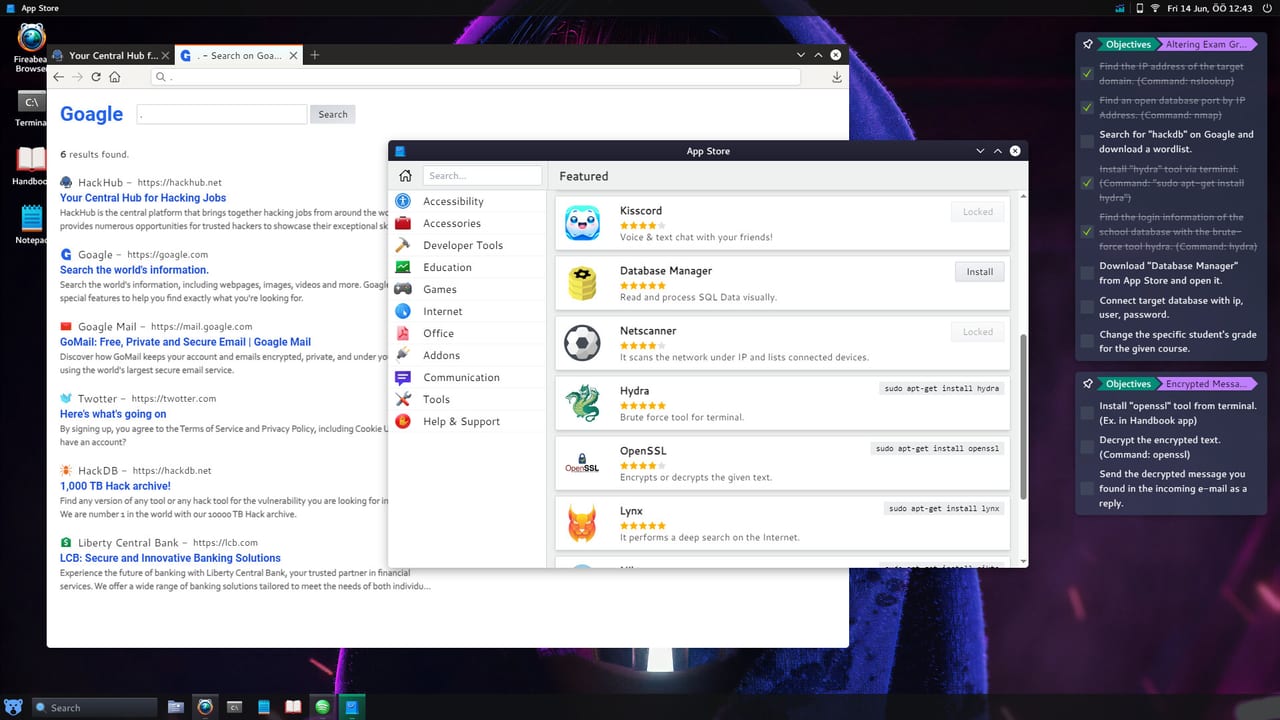
The HackHub Content SDK is HotBunny’s authoring toolkit for building missions, websites, terminal extensions, desktop and phone apps, and scripted events inside HackHub Ultimate Hacker Simulator. It shipped to players with version 1.0 on August 1, 2026 (Steam app 2980270), extending the Code++ language with structured content packages publishable through Steam Workshop. Official reference lives at docs.hotbunny.dev/hackhub — this wiki page orients operators and mod authors without replacing that documentation.
Simulation-only boundary: SDK content runs entirely inside HotBunny’s fictional OS. It must not instruct players to attack real networks, embed live exploit targets, or bridge to unauthorized external tools. Workshop moderation and #pragma meta gates enforce fiction scope — the same ethical frame as Getting Started terminal training.
What the SDK can author
| Content type | Purpose | Player-facing result |
|---|---|---|
| Quests | Mission chains with objectives, mail hooks, fail states | New contracts or story-adjacent arcs |
| Websites (FirebearBrowser) | In-fiction HTML/JS sites browsed in-game | Phishing targets, corporate portals, clues |
| Terminal Commands | Custom CLI verbs or wrappers | Training drills atop Commands |
| Desktop / Phone Apps | GUI utilities | Databases, dashboards, mini-games |
| Events | Timed triggers, NPC online state, world reactions | Dynamic NetTree or mail changes |
| Mod Settings | Config toggles exposed to players | Difficulty, theme, multiplayer flags |
Authors combine types — a Quest might require visiting a SDK Website, running a Terminal Command, then submitting proof through a Desktop App.
API namespaces overview
HotBunny documents C#-style API surfaces for Code++ and SDK scripts. Common namespaces (verify current signatures in official docs):
- Events — subscribe and emit mission/world events.
- Files — read/write virtual filesystem paths within sandbox roots.
- Network — query fictional interfaces, hosts, and connection state.
- Mail — inject threads and attachments for quest pacing.
- Bank — fictional economy transactions for training scenarios.
- Random — seeded RNG aligned with session rules.
- Storage — persistent mod data separate from main campaign saves.
- ModSettings — player-configurable options you declare.
- Shell — spawn or script terminal sessions using the same binaries as Nmap and Metasploit.
- UI — windows, buttons, and HUD elements.
- Twotter — in-fiction social feed posts and searches.
- Kisscord — chat-style messaging between NPCs and players.
- WeeChat — alternate messenger fiction for social engineering drills.
Namespaces mirror apps players already use in vanilla missions — SDK authors reuse those channels instead of inventing unsupported platforms.
Quest authoring workflow
- Define objective graph (primary + optional goals).
- Bind mail entries or Hub-style board cards to quest start.
- Specify success/fail conditions (file exfil, record edit, scan proof).
- Parameterize hosts via Random or briefing tables — never hardcode spoiler IPs eliminated by vanilla RNG.
- Test on a throwaway save before Workshop upload.
Quests should teach processes documented on the Tools Hub — discovery before Hydra, loot-driven Database Manager login, etc.
Websites and FirebearBrowser
SDK Websites render inside FirebearBrowser, HackHub’s fictional web client. Use them for:
- Login forms that accept session-scoped credentials.
- Clue pages referencing
whois-able domains. - Injectible parameters for sqlmap training packs.
Keep assets local to the mod package; hotlinking real-world attack infrastructure violates guidelines.
Terminal Commands and Shell integration
Custom commands should wrap or tutor existing binaries — not replace core packages. Example pattern (pseudocode — see official docs for exact syntax):
// Register a training command that runs nmap with briefing-safe flags
Shell.RegisterCommand("training-scan", (args) => {
    Shell.Run("nmap -sV -T3 " + args[0]);
});
Declare minimum game version 1.0.0 when using Shell APIs stabilized at full release.
Desktop and Phone Apps
GUI apps suit Database Manager-like workflows, NetTree tutors, or phone-only clues. Pair with Events so apps unlock mid-quest. Phone apps support modern fiction (2FA codes, messenger pings) without breaking desktop-only vanilla missions.
Events and Mod Settings
Events synchronize quest beats — NPC comes online, firewall rule changes, NetTree node reveals. ModSettings expose toggles (enable hints, stealth scoring) players configure before starting your pack.
Multiplayer packs must declare compatibility in metadata — see Workshop guide tags (Singleplayer, Co-op, PvP-safe).
Steam Workshop publish pipeline
- Build SDK package in HotBunny’s authoring tools or documented project layout.
- Validate with local playtest — complete quest without external walkthroughs.
- Set
#pragma meta requires "1.0.0"(or current patch) in bundled Code++. - Upload via in-game Workshop Publisher or Steam Workshop web UI.
- Write description linking prerequisite wiki pages (Hydra, NetTree, etc.).
Thumbnail and tags drive discovery — label training vs total conversion honestly.
Relationship to vanilla content
SDK missions complement HotBunny’s shipped Journalist campaign — they do not patch main story binaries. Players finish vanilla chapters in Journalist’s Sister separately from subscribed quest packs.
Full Release 1.0 notes cover SDK headline features alongside multiplayer. Early Access previews were incomplete — target 1.0 APIs when writing new mods.
Learning path for authors
- Complete manual missions using Tools Hub processes.
- Write small Code++ scripts calling Shell APIs.
- Author a single-room Quest with one Website and one Terminal Command.
- Add ModSettings and Events for pacing.
- Publish to Workshop; iterate from subscriber feedback on forum.hotbunny.dev.
Safety and policy reminders
- No real-world targets, credentials, or malware delivery.
- No instructions to disable Steam security or run external
.exeloaders. - Randomize sensitive values per session like vanilla missions.
- Label multiplayer impact accurately.
Related wiki pages
- Scripts Hub — Code++ vs Workshop overview.
- Steam Workshop Guide — subscribe/publish player workflow.
- Updates Hub — API changes after 1.0.
- Community Links — Discord and forum support.
The Content SDK turns HackHub from a consumer simulation into a platform for training scenarios — provided authors respect fiction boundaries and teach the same recon discipline HotBunny baked into app 2980270.
Frequently Asked Questions
Quick answers to common HackHub questions.
Where is the official Content SDK documentation?
HotBunny hosts API and authoring docs at docs.hotbunny.dev/hackhub, also linked from the Community Links wiki page.
Do I need the full 1.0 game to use the SDK?
Yes. The Content SDK and Workshop publishing shipped with the August 1, 2026 full release, not the Steam demo.
Can SDK quests replace the main story?
No. SDK content adds optional missions. The Journalist's Sister campaign remains vanilla HotBunny content.
What API namespaces exist for social apps?
Twotter, Kisscord, and WeeChat cover in-fiction social feeds and messengers for quests and social engineering drills.
Is SDK modding the same as Roblox exploits?
No. The SDK is official Steam Workshop authoring inside HackHub's simulation, not external game cheating.